

Wuhan rayvanbo import&export trade co.,ltd.Is a leading provider of lifting equipment and solutions, specializing in the design, manufacturing, installation, and maintenance of a wide range of lifting systems. With a strong commitment to safety, quality, and innovation, we have our team of experienced engineers and technicians work closely with clients across various sectors, including construction, manufacturing, logistics, and transportation, to deliver customized lifting solutions that meet their unique requirements. Whether it's heavy-duty cranes, hoists or specialized lifting accessories, we provide cutting-edge equipment that enhances operational efficiency and ensures worker safety.
Why Choose Us
Our factory
Wuhan rayvanbo import&export trade co.,ltd.Is a leading provider of lifting equipment and solutions, specializing in the design, manufacturing, installation, and maintenance of a wide range of lifting systems.
Our products
We main lift products including single and double girder overhead cranes, gantry crane, jib crane, wire rope hoist, electric chain hoist, fall arrester, spring balancer etc.
Production market
Our products are exported to clients in such countries and regions as usa, canada, australia, malaysia, thailand, east europe, south africa, asia, the middle east, and many other worldwide countries and regions.
Our serve
With our commitment to safety, quality, innovation, and customer satisfaction, we are dedicated to helping businesses improve their lifting operations while ensuring the well-being of their employees.

Electric Chain Hoist with Trolley
Electric chain hoist with trolley is a lifting device that consists of an electric motor, a chain, and a trolley. The hoist is designed to lift and move heavy objects in a safe and efficient manner.

A European Chain Hoist is a type of electric chain hoist that has a lifting capacity of 1–50 tons and a standard lifting height of 1–20 meters. It's designed to be more compact and lighter, and to be safer and more convenient to operate.

The intelligent electric chain hoist combines ergonomic industrial design with cutting-edge technology, offering precision lifting capabilities, adjustable speed control, and intelligent operation. Perfect for demanding industrial applications requiring high efficiency and safety.

Stage chain hoist is a light-weight electric hoist that used for securing lighting and other stage applications. It allows you to set up your equipment on the floor and lift them up when you're ready.

Fixed hoists can be operated manually or with the help of electric or hydraulic motors. They are designed to handle various types of loads, including machinery, equipment, raw materials, and finished products. Fixed hoists are available in different types and configurations, including chain hoists, wire rope hoists, and electric hoists.

Explosion Proof Electric Chain Hoist
Explosion proof electric chain hoists are designed to contain ignition hazards and prevent the entry of hazardous substances. They are often used in environments with a risk of gas or dust, such as energy production, chemicals handling, and light manufacturing.

An ER hoist is a piece of equipment used for hoisting, lifting and handling work. Chain hoists usually consist of a sturdy hoist body that includes a chain and a hook or other lifting device.

An EQ hoist is a piece of equipment that uses a chain and a lifting mechanism to complete hoisting and lifting operations. Its working principle basically includes the lifting and lowering of the chain, and the loading and releasing of the hook or other spreader.

Low Headroom Electric Chain Hoist
A low headroom electric chain hoist is a practical and efficient tool used for lifting heavy loads in various industrial settings. This type of hoist is specifically designed to operate in confined spaces where headroom is limited, making it ideal for tight work environments.
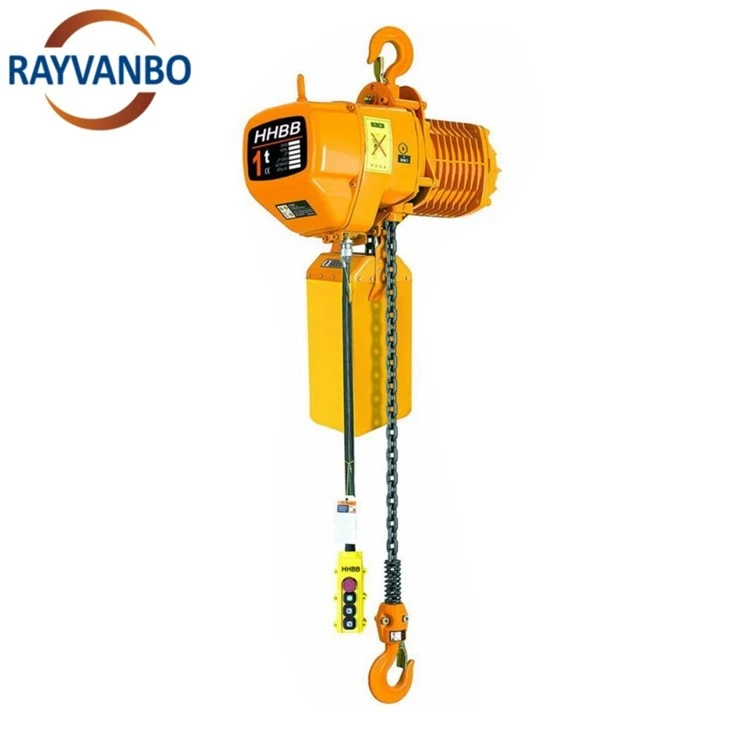
1 ton electric chain hoist are devices designed for lifting, lowering, and moving materials and products. Powered by an electric motor and equipped with a controller to manage lifting settings, they are ideal for handling heavy loads. These hoists are particularly useful when conveyors and cranes are impractical or unsuitable for the task. Other hoist types include pneumatic (air) hoists, hydraulic hoists, and manual hoists, each distinguished by its driving mechanism.Electric hoists are installed overhead to lift objects and need a power supply, making them most suitable for indoor environments. They are commonly used in settings like warehouses, automotive repair shops, machine shops, and manufacturing facilities.
Advantages of 1 Ton Electric Chain Hoist
Increased productivity
An electric chain hoist can make lifting and moving weights from one place to another simple, thus is widely used for heavy-duty, medium-duty as well as light-duty applications. This helps workers spend less time adjusting the loads as no manual effort is needed when compared to the manual hoist reducing fatigue and helping boost productivity.
High load capacity
As the name goes a motor is attached to an electric chain hoist. Hence, when compared to manual hoists, a single person operating a chain pulley block can only lift up to max. 5 tons whereas, in the case of an electric chain hoist, they can go up to 30 tons, powering the lifting capability of the machine. Also, an electric chain hoist helps with cross-travel motion, lifting a wide range of loads even more comfortably.
Cost effective
The cost of skilled labour, particularly for lifting machinery, is rising over time. Because of the minimal labour requirements, an electric chain hoist can save significantly on labour costs; it is also a one-time investment.
Electric hoists are silent
In comparison to other lifting equipment, electric hoists are relatively silent. This is especially important when you are using the hoists indoors.
The 1 ton electric chain hoist is composed of two structurally interconnected hoisting mechanisms and moving devices, which are dragged by a hoisting motor and a moving motor respectively. The motor of the hoisting mechanism drags the wire drum through the reduction box. The lifted wire drum is driven by the conical motor through the reduction box, and the main drive shaft is connected with the conical disc of the electromagnetic brake. The electrical powered chain hoist moves back and forth on the i-beam by the action of the guide wheel, and the guide wheel is driven by another motor through the cylindrical reduction box. The traveling mechanism of the electric hoist is provided with an electromagnetic brake, and the movement in the front and rear directions is restricted by a mechanical striker.
The main control valve controls the three-phase motor.
The chain block equipment needs power when lifting heavy loads, so the motor of the electric chain hoist is the main driving force, and it is also its role that promotes the operation of the electric hoist. Therefore, for the hoist to be lifted smoothly, the motor is a very important component, which can not only ensure safety, but also realize the smooth lifting of the hoist.
The lifting sprocket makes the lifting stable.
The motor is relative to the heart of the person, and the chain is the arm. The motor can play a power role, and the chain is the connection role, which is indispensable. The chain has many advantages, such as being very light and durable, and it is a critical component for lifting. The hoisting sprocket can control the hoisting chain well, and it will also appear very safe and very stable during the operation.
Effective braking of the braking system.
During the lifting process or at the end, the braking system will work automatically, at the same time, which is generally done by the braking system. Moreover, the use of a variety of disc brake systems can make the brake system run safer and more orderly.
Motor: The motor is the primary power source of the electric chain hoist. It provides the mechanical force to lift the load by turning electrical energy into rotational motion.
Chain: The chain is an essential component of the hoist, as it is the lifting medium that connects the load hook to the hoist body. It is usually made of high-strength alloy steel and is designed to withstand heavy loads.
Load hook: The load hook is the part of the hoist that directly engages with the load being lifted. It is typically equipped with a latch or safety catch to prevent accidental release of the load.
Hoist body or frame: The hoist body is the main structure of the hoist, housing the motor, gearbox, and other internal components. It is designed to be durable and capable of withstanding the stresses of lifting heavy loads.
Gearbox: The gearbox is responsible for reducing the motor's high-speed rotation to a slower speed with higher torque, allowing the hoist to lift heavy loads with ease.
Brake: Electric chain hoists are equipped with a brake mechanism that holds the load in place when the motor is not actively lifting or lowering it. The brake ensures safety and prevents the load from accidentally dropping.
Control panel: The control panel houses the electrical controls and switches for operating the hoist. It allows the user to control the lifting and lowering of the load as well as other functions, such as emergency stop and limit switches.
Chain container: The chain container is a protective housing that encloses the length of chain not in use during lifting operations. It prevents the chain from tangling and keeps the work area safe and organized.
Push button pendant or remote control: The hoist is typically operated using a push-button pendant or a remote control. These control devices allow the operator to control the lifting and lowering of the load from a safe distance.
Limit switches: Limit switches are safety devices that control the travel range of the hoist's hook. They are designed to prevent overtravel and protect against potential accidents caused by lifting loads beyond the safe limits.
Weight load
The most basic factor to consider is the lifting capacity of the hoist. Your business might require different lifting capacities,industry needs, and specifications. It is important to choose the right electric chain hoist that supports more weight than the actual load limit as a safer option.
Application
The electric chain hoists differ in varying applications. There might be a difference in the lifting capacity, speed, and frequency of electric hoists. What are you using it for? Will you be using it for product assembly, or what other applications will you be using it for in your business?
Speed of lifting
Electric hoists have different lifting speeds and frequencies of lifting. If you are in the production business, you might need high-paced electric hoists. Whereas, if your business requires less lifting and lowering of loads, then you'd need slow or medium-paced hoists.
Working environment
Each business facility might operate in a different working environment. Some might require a very hot temperature, and some might require a cold temperature. So, with the fluctuations in temperature, there are few possibilities for any fissures or damages.
Safety features
It is also best to choose electric hoists with safety features such as load limiters, adjusting brakes, and loading protection. It provides a safe and secure environment, minimizing damage and accidents to the workspace or to the employees.
Duty cycle
This refers to the number of hours the hoists operate. The duty cycle has an impact on the longevity of the hoists and on how long the hoist runs continuously.
Height of the lift
The height of the lift is the height from the lowest load level up to the beam or hoist. It is recommended to purchase electric chain hoists that are taller rather than short electric rope hoists.
Application of 1 Ton Electric Chain Hoist
Engine hoists
Engine hoists, or engine cranes, are used to assist the workers in the installation and maintenance of engines of automobiles. They are designed to lift the engine under the automobile hood. Their electric hoists are mounted on top of the rigid and portable structural frame. The structural frame has wheels installed at its base to easily maneuver the hoist over the automobile, as well as to transport it around the machine shop.
Overhead cranes
The installation of overhead cranes is planned during the early stages of a building's construction, as they require a much greater amount of structural support. Overhead cranes lift the heaviest loads at the highest lifting heights in an enclosed facility.
Jib cranes
A jib crane has a lifting fixture that primarily consists of two large beams constructed to form a cantilever. The mast, or pillar, is the vertical beam of the fixture that supports the reach. The reach, or boom, is the horizontal beam of the fixture wherein the electric hoist travels to position the load.
Floor-mounted jib cranes
Floor-mounted jib cranes are self-supporting structures with a large mast fixed to the floor. These cranes are designed to support the loads of primary cranes and come in various types and designs to enhance lifting capabilities. For instance, drop-mounted cantilever jib cranes feature an adjustable boom that allows for modifications in lifting height. Many floor-mounted jib cranes are capable of rotating up to 360°.
Wall-mounted jib cranes
Wall-mounted jib cranes are attached to a wall or column that must be structurally sound to support them. Their range of rotation is typically limited to 200°. There are two main types of wall-mounted jib cranes: Cantilever wall-mounted jib cranes, which provide maximum clearance both above and below the boom and apply minimal force to the supporting column, and tie-rod supported wall-mounted jib cranes, which use a wall bracket and a tie rod for support. With no additional support structure beneath the boom, these cranes allow the electric hoist to travel the full length of the reach.
Articulated jib cranes
Articulated jib cranes feature a mast and two boom arms connected by joints that allow them to flex or fold. These cranes can be installed on the floor, ceiling, wall, or a bridge crane. The primary boom arm, which supports the load, can rotate up to 360°, while the rotation of the secondary boom arm varies based on the crane's mounting location. Articulated jib cranes offer flexible load movement in multiple directions.
Do not use overloaded, weigh the hoisted object when necessary, and see if the electric chain hoist can be used for lifting after knowing the exact weight;
The lifting and reversing buttons on the chain hoist operation control box, as well as the lifting and lowering buttons must not be pressed at the same time;
Avoid frequent jog movement during work (for example, press the forward button frequently and immediately press the reverse back button immediately after releasing it);
Under any circumstances, there should be no obstructions under the body structure, the i-steel track should also be intact and unblocked, and the movement of the electric chain hoist should be unimpeded;
The height of the electric chain hoist and the height of heavy objects to be hoisted should be calculated for the selection of slings;
Continuous lifting and movement will inevitably cause the equipment to be contaminated with dirt and impurities. When using it, always pay attention to keeping the lifting equipment such as chain electric hoist clean and lubricated to prevent debris from entering the body;
When moving the operation instruction again, if you feel obstruction, you should stop the movement, so as not to cause damage to the electric hoist and the goods;
For some large objects, it should be considered whether to install two or more electric chain hoists for joint lifting or alternate use.
How to Maintenance 1 Ton Electric Chain Hoist
Clean and lubricate the chain
Debris and rust are the most common sources of chain wear. If there's too much buildup of grit or rust, the chain can become difficult to move or stiff.
Depending on what your chain hoist is used for, you should dismantle it completely for cleaning and oiling once or twice a year.
Be aware of common issues with chain hoists
It's hard to maintain a piece of equipment without understanding how it works. If you do know what can happen, however, you'll be more than capable of identifying when your equipment's effectiveness is being affected by wear and tear.
All three kinds of chain hoists – hand chains, lever ratchets, and differentials, use some combination of a hook and a chain to lift or move heavy objects. Wear and tear can affect the ability for the chain to rotate, which is the source of many problems. Luckily, you can help extend your chain's lifespan with regular maintenance.
Perform regular inspections
Osha requires that certain inspections and tests be carried out on chain hoists on a regular basis.
Every day, the crane or hoist operator should perform a visual inspection of their equipment to ensure it is working properly.
Every month, a detailed inspection should be conducted, documenting damage to the equipment, as well as existing wear and tear.
Perform all necessary testing
The chain and its hoist are two parts of the same tool. You should inspect the hoist and test it regularly to confirm it functions properly.
If you perform these tests, you will be confident that your hoist will operate under various conditions, and any performance-related issues will be made evident.
Every quarter, perform a service load test, observing how well your chain hoist functions when lifting various objects of different weights.
Video
FAQ
Hot Tags: 1 ton electric chain hoist, China 1 ton electric chain hoist manufacturers, suppliers, factory, chain hoist, gantry crane hoist, industrial crane operator, bridge crane hoist, heavy duty crane operator, galvanized rope


