

Overhead Crane
-
 Single Girder Overhead CraneType:European type / China normal typeLift Capacity:1 ton, 2 tons, 3 tons, 5 tons, 10 tons, 16 tons, 20 tons, 32 tonsLift Span:7.5m to 20m or customizedWarranty:12 monthsAdd to Inquiry
 -
 RAYVANBO Aluminium Alloy Crane Track SystemProduct Name:Aluminum Alloy Track CraneRated Loading Capacity:125kg-2000kgWeight (KG):2000kgMarerial:Aluminium AlloyAdd to Inquiry
 -
 5 10 15 20 30 Ton Single Double Girder Overhead Crane Bri...Type:European type / China normal typeLift Capacity:1 ton, 2 tons, 3 tons, 5 tons, 10 tons, 16 tons, 20 tons, 32 tonsLift Span:7.5m to 20m or customizedWarranty:12 monthsAdd to Inquiry
 -
 Custom Single Girder Overhead Bridge Crane | Electric Hoi...Product Name:Overhead CraneType:European type / China normal typeLift Capacity:1-100 Ton(Can be customized)Lift Span:3~28m or customizedLifting height:3~48m or customizedAdd to Inquiry
 -
 European Type Single Girder Bridge CraneType:European type Single Girder Overhead CraneLift Capacity:1 ton, 2 tons, 3 tons, 5 tons, 10 tons or CustomizableLift Span:7.5m to 20m or customizedWarranty:12 monthsAdd to Inquiry
 -
 European Style Single Girder Overhead Crane 10 Ton CapacityProduct Name:Overhead craneType:China type/European typeLift Capacity:1-30ton(Can be customized)Lift Span:1-20m(Can be customized)Add to Inquiry
 -
 Single Double Girder 5 Ton 10 Ton 20 Ton 30 Ton 50 Ton Ov...Product Name:Overhead craneType:Chinese type/European typeLift Capacity:1-50ton(Can be customized)Lift Span:1-20m(Can be customized)Add to Inquiry
 -
 1t 2t 3t 5t 10t 20t Overhead Crane With Remote Control Eu...Product Name:Overhead craneType:Chinese type/European typeLift Capacity:1-32ton(Can be customized)Lift Span:1-20m(Can be customized)Add to Inquiry
 -
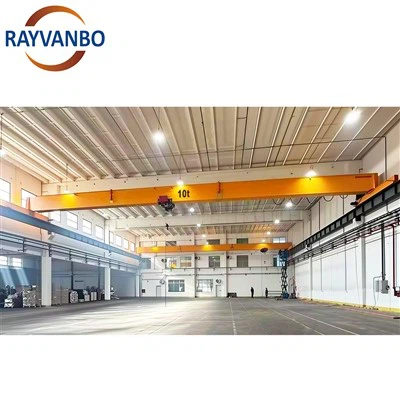 Electric Overhead CraneRayvanbo overhead crane is an electric rail-mounted lifting system designed for industrial workshops and warehouses, handling materials from 1 ton to 32 tons overhead while keeping the floorAdd to Inquiry
 -
 Overhead Crane For WorkshopRayvanbo overhead bridge crane is an electric rail-mounted lifting system that travels along elevated workshop beams, handling 1-ton to 32-ton materials overhead while leaving the entire floorAdd to Inquiry


Tel: +86-027-87788375
Mobile:+86 13720388778
- Email: info@rayvanbo.com
- Add: No.50 Xudong street, Wuchang District, Wuhan City, Hubei Province, China
Why Choose Us
Advanced Equipment
Equipment based on the latest technological developments has higher efficiency, better performance and stronger reliability.
Rich Experience
Our company has many years of production work experience. The concept of customer-oriented and win-win cooperation makes the company more mature and stronger.
After-Sales Service
The professional and thoughtful after-sales team makes you worry-free after-sales. Intimate service and strong after-sales team support.
Professional Team
Our professional team collaborate and communicate effectively with one another, and are committed to delivering high-quality results. They are capable of handling complex challenges and projects that require their specialized expertise and experience.
In the simplest of terms, an overhead crane is a machine, or piece of equipment, that allows you to lift and move heavy materials from one location to another in a precise manner. There is no “one size fits all” approach to defining an overhead crane, as each overhead crane is carefully designed and engineered for a specific purpose or application to suit a business' material handling needs.
Clean Floor space
Your floor space is cleared up because your supports for the crane are out of the way. Typically your crane provider can come up with a column design that is freestanding and can be aligned with your building columns or along walls. You can choose a ceiling mounted crane (typically on new building designed for the loadings) or you can support the crane from the floor. Sometimes a combination of the two can be used with some supports from the floor and some from the ceiling of your building.
Safety
The crane operator can put himself into the optimum location to safely move the load. The fork lift creates blind spots which are inherent with the structure around the operator. The fork lift can be prone to overturning (which is the leading cause of death with a forklift), Pedestrian can be struck by a forklift, driver or employee can be crushed by a forklift, or the driver can fall from the forklift. Overhead bridge cranes can also be outfitted with anti-collision devices to keep them from colliding with cranes in the same bay or end stops.
Customizable and adaptable
Overhead bridge cranes are very versatile when it comes to below the hook accessories. The types available are limitless. Below the hook accessories include spreader bars, c-hooks, weight scales, custom designed lifting tooling, manipulators, and vacuum lifts to name a few. Many cranes have several different below the hook tools which are changed out for the particular job.
Heavier payloads
Heavier loads can be handled while keeping your plant personnel away from the load. Forklifts require your operator to be within close proximity to the load. With an overhead bridge crane the operator can rig the load and then move away from danger when using the above referenced radio or independent traveling pushbutton station.
Complete coverage
Your entire plant can be covered with no dead spots of coverage. A crane can travel right over the load, even without a clear path or aisle. This allows the most flexibility when setting up your plant design.
Inexpensive operating costs
Operating costs are very inexpensive with a bridge crane. From no energy requirements for a completely manual system, to a very economical three phase system. There is no need to charge batteries or have tanks filled. The bridge crane is always ready to work!

Gantry Cranes
Gantry cranes feature legs supporting the crane's trolley, hoist, and bridge. This design allows the legs to run on rails affixed to the floor instead of overhead. The approach is most common outdoors, where installing columns and beams is impractical. They're also useful in facilities with limited overhead clearance for suspended runways.
Workstation Cranes
These models are ideal for moving up to 2 tons of materials within a compact work area. They can be stand-alone or ceiling-mounted solutions and are suitable for repetitive workflows. These options usually offer expansion capability with a modular design and are highly customizable for increased versatility.
Jib Cranes
Unlike the equipment above, jib cranes have a unique design without tracks or runways. Numerous styles are available, including wall-mounted and stand-alone options. This variety between models provides a wide range of spans, load capacities, and heights. The Spanco jib crane selections are ideal for applications where a higher degree of articulation is necessary. These solutions deliver up to 360-degree rotation and generous load capacities in a compact footprint. Your facility saves floor space while enjoying precise maneuverability.
Monorail Cranes
Monorail cranes are common fixtures in production and assembly lines. These machines get their name from their single-path design, where the trolley carries the hoist along one rail. The trolley mounts to the underside of an I-beam, using the beam's bottom to take materials from one destination to another in a straight line.
Application of Overhead Crane
Warehousing
The first industry that comes to mind when determining the need for an overhead crane is warehousing where supplies, equipment, and materials are constantly moved, positioned, and prepared. A major benefit of an overhead crane in warehousing is the movement of large items from storage to the shipping dock in a timely manner.
Assembly
Industries that assemble large equipment require a means for lifting and moving incomplete assemblies from one location to another for completion. Forklifts, AGVs, and other forms of material handling are not adequate or safe, which makes the use of an overhead crane a necessity. Assemblies can be moved easily as a natural part of the production process.
Transportation
The parameters that apply to warehousing are also true for transportation where heavy bulky products have to be loaded onto planes, trains and trucks. Overhead cranes can easily position large materials to be placed for transport. This can be especially true for overseas shipping where huge containers and materials have to be lowered into the holds of ships.
Equipment Repair
When the repair of a punch press or other factory equipment is required, overhead cranes assist in facilitating the repair by gradually moving and positioning pieces for easy access. Gantry and bridge cranes can remove heavy equipment from their permanent location to a repair shop and then return them. Overhead cranes make it easier to lift machines up and over other equipment to be placed at a repair station.
Bridge Beam
The bridge beam is the main horizontal beam that the trolley moves across. It is usually made of steel and can be customized to fit the application's specific needs.
Girders
Girders support the bridge beam and connect it to the end trucks. They come in various shapes and sizes depending on the load capacity needed for the application.
End Truck
The end trucks are what support and move along the facility's runways. They can be powered or non-powered depending on what is best suited to your needs. Additionally, some cranes also come with rotatable truck options that allow for more versatility. Thus, providing movement across different floors, surfaces, and even terrain.
Hoist
The hoist carries the load attached to a hook or fork at its end. The hoist may have an electric power motor, hydraulics, pneumatics, or gravity, depending on what type of crane you have purchased and what power source best fits your needs.

Capacity and Service Rating
The load rating capacity is the maximum load weight a crane can handle. It's important to note the load capacity and frequency of operation. Operating a crane above its load rating capacity is extremely dangerous and can cause serious damage to your new system. Be sure that the maximum weight requirements of your application are less than the load rating capacity of the crane. Knowing this information will also help you to identify the right service rating classification for your new crane.The CMAA offers six different service-rating classes. Each service rating is used to describe the type of service performed and frequency of use. The service rating helps users to select a crane designed for their particular application.
Structural Components
Most overhead cranes are made from welded steel plates or aluminum sections. The more steel, the heavier the crane. Consider your service classification and compare it to the type of crane you are interested in purchasing. Spanco A-Series Gantry Cranes, for example, can either be steel or aluminum. Whereas aluminum gantry cranes are designed for lightweight applications and total portability, a steel gantry crane will provide a higher load rated capacity and is designed for heavier applications. Understanding these options will help you to make the best choice for your operation and control some of the structural elements that impact the weight of the crane and its cost.
Mechanical & Electrical Components
Overhead cranes in general provide a variety of options beyond design and structure. Choosing the best mechanical and electrical options can be a daunting task without the right approach. But, if you consider the needs of your application and facility first, you can eliminate some of that confusion. There are multiple mechanical and electrical component options for each type of overhead crane we manufacture. Knowing what each component does and how it will impact your particular application will help you to decide which options are necessary.
Motor Controls & Operator Controls
Another important option to consider when choosing the right system for your operation is the use of motor controls. Electrical control systems allow you to manipulate bridge and trolley motions for increased precision and safe, controlled lifting. These components also impact the cost of the crane, so making the best choice for your operation is crucial. If you choose to purchase a motorized system, ask your supplier if they provide speed control. A variable frequency drive, for instance, is an adjustable-speed drive used to control motor speed and torque by varying motor input frequency and voltage. VFD provides cushioned acceleration and deceleration, which is especially important when handling fragile or oversized loads. At Spanco, we provide VFD technology on every motorized system that we manufacture. Knowing what your supplier provides with each system and how it will benefit your application is a fundamental step in your buying process.
Overhead Crane Installation Guide
Select the right overhead crane
Before you can install an overhead crane, you need to select the right one for your needs. There are many different types of overhead cranes available, including single-girder overhead cranes, double-girder overhead cranes, Monorail cranes, and JIB cranes… Each type of crane has its own advantages and disadvantages, so you need to carefully consider your requirements before making a decision.
Prepare the infrastructure for overhead crane installation
After choosing the appropriate crane, you need to prepare the infrastructure to install the crane. Infrastructure includes:Clean and clear the crane installation space, neatly place items, remove obstructions, and create service space.Connect power lines and supply power to the crane, including horizontal wires, vertical wires, cables, electrical cabinets, switches, buttons… You need to make sure the power lines are arranged neatly and safely. Complete, no breaks, short circuits, or fires. You also need to check the voltage, current, fuse, protection, and ground… to match the crane's requirements.
The overhead crane installation
Once the infrastructure is in place, you can begin the installation of the overhead crane. The installation process should be carried out by qualified technicians who are familiar with the safety procedures involved.The main girder is the main support structure of the crane. It should be installed level and plumb, and securely attached to the foundation or columns.
Test and inspect the crane
Once the overhead crane is installed, you need to test and inspect it before putting it into operation. The testing and inspection process should include the following steps:Crane test run: This is the step to check the operation of the crane, including lifting, horizontal movement, vertical movement, control, and alarm… You need to make sure the crane operates smoothly, without any problems. jam, vibrate, shake, make noise.
Regular Inspections
Inspections conducted on a regular basis assist find possible problems before they develop into serious ones. Daily, monthly, and yearly inspections can be planned.Before the start of each shift, daily inspections involve looking for any loose or damaged parts, wear, or strange noises. Furthermore, the operation of safety tools like limit switches and emergency stop buttons can also be checked.A more thorough inspection of the crane's parts is performed during monthly inspections. This entails inspecting electrical connections, checking wire ropes and electric chains for damage, and looking for breaks or abnormalities in structural components. Here, it is important to use thorough inspection checklists and to adhere to the manufacturer's service and maintenance recommendations.
Stick to the Manufacturer's Guidelines
Installing an overhead crane in your plant entails significant financial investment, and to assist you in maintaining it effectively, the crane manufacturer always provides a comprehensive handbook or maintenance schedule book. This resource contains service advice tailored to the specific crane's duty cycle and capabilities.It is crucial to strictly adhere to the manufacturer's guidelines when it comes to crane maintenance, including lubrication schedules and inspection intervals. By following these recommendations carefully, you can ensure the optimal performance and longevity of your crane.
Lubrication and Cleaning
To reduce friction and stop premature wear, the working elements of the crane must be lubricated often. Areas like wire ropes, sheaves, gears, and bearings should be lubricated. Additionally, routine crane cleaning helps get rid of corrosive substances, dirt, and other things that can harm its components.
Operating Environment Considerations
The operating environment plays a vital role in determining the lifespan of overhead cranes and their components. To safeguard the crane against adverse environmental conditions such as excessive heat, chemical exposure, fumes, steam, dust, or high moisture levels, special metal coatings may be necessary.Failure to consider these factors during the design and quotation phases can lead to corrosion, oxidation, and accumulation of dirt and grime on crane components. Taking proactive measures to address environmental challenges is crucial to ensure the longevity and optimal performance of overhead cranes.
Our Factory
Wuhan Rayvanbo Import&Export Trade Co.,Ltd.is a leading provider of lifting equipment and solutions, specializing in the design, manufacturing, installation, and maintenance of a wide range of lifting systems. With a strong commitment to safety, quality, and innovation, we have.Our team of experienced engineers and technicians work closely with clients across various sectors, including construction, manufacturing, logistics, and transportation, to deliver customized lifting solutions that meet their unique requirements. Whether it's heavy-duty cranes, hoists or specialized lifting accessories, we provide cutting-edge equipment that enhances operational efficiency and ensures worker safety.
FAQ
We're well-known as one of the leading overhead crane manufacturers and suppliers in China. Please rest assured to wholesale high quality overhead crane for sale here and get quotation from our factory. For price consultation, contact us.
gantry lifting crane, crane control, crane testing