


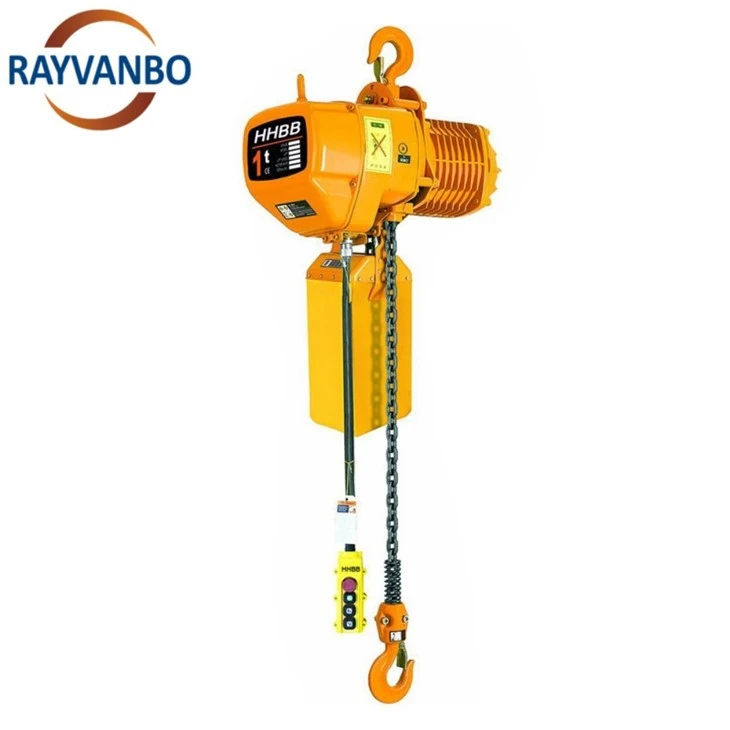


Introduction to 1 Ton Electric Chain Hoist
A 1 ton electric chain hoist is a reliable and efficient tool used in various industries to lift and move heavy objects weighing up to 1000 kg or 2000 pounds. With its electric motor, it provides smooth and effortless lifting, making it ideal for repetitive tasks requiring precision and speed.

Advantages of 1 Ton Electric Chain Hoist
A 1 ton electric chain hoist is a lifting equipment used for handling heavy objects, commonly found on industrial and construction sites. Here's a general product advantages of a one-ton chain hoist:
- Loading Capacity: The main feature of the 1 ton electric chain hoist is its ability to lift objects weighing one ton (1000 kilograms), making it suitable for handling small and medium-sized heavy objects.
- Structure and Materials: Chain hoists are typically constructed from high-strength alloy steel to ensure durability and safety. They consist of chains, hooks, main shells, etc.
- Safety Features: One-ton chain hoists are usually equipped with safety features such as limiters, anti-slip devices, and overload protection to prevent accidents and overload operations.
- Ease of Operation: These hoists are designed to be user-friendly, allowing easy control of movement through handles, buttons, or remote controls.
- Applicable Scenarios: One-ton chain hoists find wide applications in industrial manufacturing, construction, warehousing, logistics, and other fields for lifting and carrying objects weighing less than one ton.
- Lightweight and Portable: Designed with mobility in mind, chain hoists are typically lighter than other lifting equipment, making them easier to carry and install.

Characteristics of 1 Ton Electric Chain Hoist
Here's a more detailed description of a 1 ton electric chain hoist, including technical details:
- Loading Capacity: Maximum Carrying Capacity: 1000 kg (1 ton)
- Loading Range: Suitable for heavy goods handling tasks weighing 1000 kg and below.
- Structure and Materials:
- Main Shell: Constructed from high-strength alloy steel for durability and corrosion resistance.
- Chain: High-quality alloy steel chain, heat-treated and surface-treated for strength and wear resistance.
- Hook: Intensively heat-treated with a safety locking device.
- Security Features:
- Overload Protection: Equipped with an overload protection device to automatically stop lifting operations in case of overload.
- Limiter: Limits lifting and lowering strokes, preventing chain overstretching.
- Power Supply and Electronic Control System:
- Electric Hoist: Equipped with an electric drive system, usually utilizing single-phase or three-phase power supply.
- Manual Hoist: Operated by a manual sprocket, suitable for environments without power supply or temporary usage.
Parameters
|
Model |
Single Lift Speed |
||||||||||
|
0.5-01S |
01-01S |
01-02S |
02-01S |
02-02S |
03-01S |
03-02S |
03-03S |
05-02S |
7.5-03S |
10-04S |
|
|
Capacity (Ton) |
0.5 |
1 |
1 |
2 |
2 |
3 |
3 |
3 |
5 |
7.5 |
10 |
|
Lifting speed(m/min) |
7.2 |
6.8 |
3.6 |
6.6 |
3.4 |
5.6 |
3.3 |
2.2 |
2.8 |
1.8 |
2.8 |
|
Motor Power (kw) |
1.1 |
1.5 |
1.1 |
3 |
1.5 |
3 |
3 |
1.5 |
3 |
3 |
3*2 |
|
Traveling speed(m/min) |
Slow 11m/min or fast 21m/min |
||||||||||
|
Traveling Motor Power(kw) |
0.4 |
0.4 |
0.4 |
0.4 |
0.4 |
0.4 |
0.4 |
0.75 |
0.75 |
0.75 |
0.75 |
|
Power Supply |
3-Phase 380V 50Hz / according to client's request |
||||||||||
|
Control Voltage |
24V 36V 48V |
||||||||||
|
NO.of Load Chain |
1 |
1 |
2 |
1 |
2 |
1 |
2 |
3 |
2 |
3 |
4 |
|
Chain Size |
ɸ6.3 |
ɸ7.1 |
ɸ6.3 |
ɸ10.0 |
ɸ7.1 |
ɸ11.2 |
ɸ10.0 |
ɸ7.1 |
ɸ11.2 |
ɸ11.2 |
ɸ11.2 |
|
I-Beam(mm) |
58-153 |
58-153 |
58-153 |
82-178 |
82-178 |
82-178 |
100-178 |
100-178 |
100-178 |
100-178 |
100-178 |
|
Model |
Double Lift Speed |
||||||||||
|
0.5-01D |
01-01D |
01-02D |
02-01D |
02-02D |
03-01D |
03-02D |
03-03D |
05-02D |
7.5-03D |
10-04D |
|
|
Capacity(Ton) |
0.5 |
1 |
1 |
2 |
2 |
3 |
3 |
3 |
5 |
7.5 |
10 |
|
Lifting speed(m/min) |
7.2/2.4 |
6.9/2.3 |
3.6/1.2 |
6.6/2.2 |
3.3/1.1 |
5.6/1.8 |
3.3/1.1 |
2.2/0.8 |
2.8/0.9 |
1.8/0.6 |
2.8/0.9 |
|
Motor Power(kw) |
1.1/0.37 |
1.5/0.6 |
1.1/0.37 |
3.0/1.0 |
1.5/0.6 |
3.0/1.0 |
3.0/1.0 |
1.5/0.6 |
3.0/1.0 |
3.0/1.0 |
3.0/1.0 |
|
Traveling speed(m/min) |
Slow 11m/min or fast 21m/min |
||||||||||
|
Traveling Motor Power(kw) |
0.4 |
0.4 |
0.4 |
0.4 |
0.4 |
0.4 |
0.4 |
0.75 |
0.75 |
0.75 |
0.75 |
|
Power Supply |
3-Phase 380V 50Hz / according to client's request |
||||||||||
|
Control Voltage |
24V 36V 48V |
||||||||||
|
NO.of Load Chain |
1 |
1 |
2 |
1 |
2 |
1 |
2 |
3 |
2 |
3 |
4 |
|
Chain Size |
ɸ6.3 |
ɸ7.1 |
ɸ6.3 |
ɸ10.0 |
ɸ7.1 |
ɸ11.2 |
ɸ10.0 |
ɸ7.1 |
ɸ11.2 |
ɸ11.2 |
ɸ11.2 |
|
I-Beam(mm) |
58-153 |
58-153 |
58-153 |
82-178 |
82-178 |
82-178 |
100-178 |
100-178 |
100-178 |
100-178 |
100-178 |
Applications of 1 Ton Electric Chain Hoist
1 Ton Electric Chain Hoists find extensive applications across various industrial and construction scenarios to meet diverse lifting and handling needs. Here are some primary application areas:
- Manufacturing: Used for lifting components, machinery, equipment, and performing assembly and installation operations on production lines.
- Construction Sites: Employed for lifting building materials, installing structural parts, and conducting high-altitude operations.
- Warehousing and Logistics: Facilitate the transportation, loading, stacking, and sorting of goods in warehouses.
- Shipbuilding and Maintenance: Utilized for lifting and installing ship hull components and performing ship maintenance tasks.
- Mining and Quarrying: Deployed to lift and move heavy materials to support mining activities.
- Energy Industry: Used for hoisting and installing power generation equipment and transmission cables in power plants and energy facilities.
- Chemical and Heavy Industry: Transport chemical raw materials, equipment, and large industrial components in chemical plants and heavy industries.
- Metallurgical Industry: Employed for hoisting and carrying metal billets, steel products, etc., in metallurgical processes.
- Transportation: Used for loading and unloading cargo in the logistics and transportation industries.
- Food Processing: Transport and process food raw materials and finished products in food processing plants.

Shipping & Packaging


1 Ton Electric Chain Hoist Manufacturers Questions Guide:
FAQ
Q: What are the advantages of electric chain hoists compared to other hoists?
Strong Adaptability: Suitable for various working environments, including factories, warehouses, workshops, etc., and various industries, such as manufacturing, construction, etc.
Compact Structure Design: Typically adopting a compact structure design, chain hoists are suitable for working environments with limited space, offering more flexibility and operability.
Reliable Safety System: Equipped with multiple safety systems such as overload protection, emergency stop button, limit switch, etc., ensuring safety during operation.
Flexible Operation: Providing two operating modes-electric and manual-allowing the operator to choose the appropriate method, thus improving operational flexibility.
Adjustable Speed Function: With the adjustable speed function, the operator can choose the appropriate lifting speed according to specific lifting task requirements, thereby improving flexibility and accuracy.
Strong Durability: Made of high-strength materials, chain hoists offer good wear resistance and corrosion resistance, ensuring equipment stability and long-term durability.
Suitable for Low-Altitude Operations: Generally suitable for low-altitude operations with relatively low lifting heights, making them suitable for places with height restrictions.
Easy Maintenance: Featuring a relatively simple structure and easy-to-maintain parts, chain hoists reduce maintenance costs and downtime.
Relatively Low Cost: Compared to more complex lifting equipment, chain hoists usually have a relatively low cost, making them suitable for applications with budget constraints.
Q: What should you pay attention to when installing an electric chain hoist?
Selection of Mounting Beams: If the chain hoist needs to be mounted on a beam, ensure the beam is strong and stable enough to support the hoist's load and meets relevant design requirements.
Fastening: Ensure the hoist is securely mounted to the support structure using appropriate fastening methods to prevent movement or tilting during operation.
Selection of Suspension Points: Select appropriate suspension points to ensure they are strong enough and will not be damaged by the load.
Power Supply and Control Devices: Ensure the power supply connection is reliable, cables and control lines are properly laid out, and check the normal operation of control devices.
Chain/Rope Installation: For chain hoists, ensure the chain is installed correctly and properly lapped. For wire rope hoists, ensure the wire rope is installed and secured correctly.
Safety System Inspection: After installation, conduct a comprehensive inspection of the safety system to ensure overload protection, emergency stop buttons, limit switches, etc., are working properly.
Balance Adjustment: Ensure the load remains balanced when lifting and moving laterally to prevent equipment tilting or instability.
Operating Space: Ensure there is enough operating space around the installation location to prevent the hoist from colliding with other objects during movement.
Safety Signs: Add appropriate safety signs at the installation location, including operating instructions, load capacity, emergency stop location, etc., so operators can use the equipment correctly.
Compliance with Standards: Ensure the installation and use of chain hoists comply with relevant national and regional lifting machinery safety standards and regulations.
Q: How do you maintain a chain hoist?
Chain Inspection: Inspect the chain regularly to ensure there are no obvious wear, deformations, or cracks on the links. Replace the chain promptly if any problems are found.
Cable and Power Cord Inspection: Regularly check cables and power cords for integrity to avoid breakage or exposed cores. Ensure the power cord is firmly connected to prevent short circuits and power outages.
Safety System Testing: Regularly test the hoist's safety system, including overload protection, emergency stop buttons, limit switches, etc., to ensure they function reliably when needed.
Wire Rope Inspection: For wire rope hoists, check the wire rope for broken wires, twists, or other damage regularly. Check the tension of the wire rope to ensure it is within the normal working range.
Controller and Switch Inspection: Regularly check the manipulator, remote control, and control switch's working condition to ensure smooth operation.
Gearbox Lubrication: If the hoist has a gearbox, regularly check the gearbox's lubrication to ensure sufficient lubrication. Replace the lubricant according to the manufacturer's recommendations.
Fixing Bolt Inspection: Check all fixing bolts and nuts on the hoist to ensure they are tight, especially when adjusting the load height.
Motor and Braking System: Check the motor and braking system's working condition to ensure the motor operates normally, and braking is reliable.
Operator Visual and Functional Inspection: Check the operator's appearance to ensure buttons or handles are not worn or damaged. Verify the function of the operator to ensure each button or handle operates normally.
Maintenance Records: Keep detailed maintenance records, including maintenance activities and inspection results, to track the hoist's maintenance history and plan future maintenance.
Q: How can you extend the life of a chain hoist?
Proper Use: Follow the hoist's instruction manual and operating procedures. Avoid exceeding the hoist's rated load capacity and overuse. Prevent accidental impacts and emergency stops to reduce damage to the hoist and its components.
Reasonable Loading: Ensure the load is even when using the hoist and avoid operating outside its load capacity. Do not use the hoist for tasks beyond.
Hot Tags: 1 ton electric chain hoist, China 1 ton electric chain hoist manufacturers, suppliers, factory, limit switch electric chain hoist, bronze electric chain hoist, safe electric chain hoist, sprocket operation electric chain hoist, commercial electric chain hoist, sprocket handling electric chain hoist


