As a leading supplier of Crane Wheel Blocks, I've witnessed firsthand the critical role that various components play in the efficient and safe operation of cranes. Among these components, the gearbox in a crane wheel block stands out as a key element that significantly impacts the crane's performance. In this blog, I'll delve into the functions, importance, and working principles of the gearbox in a crane wheel block.
Understanding the Crane Wheel Block
Before we explore the role of the gearbox, it's essential to understand what a crane wheel block is. A crane wheel block is a fundamental part of the crane's movement system. It consists of wheels, axles, bearings, and other components that enable the crane to move along the runway. The wheel block system is designed to support the crane's load and ensure smooth and stable movement. You can learn more about the Wheel Block System on our website.
The Role of the Gearbox in a Crane Wheel Block
1. Torque Conversion
One of the primary functions of the gearbox in a crane wheel block is torque conversion. Torque is the rotational force that causes an object to rotate. In a crane, the motor generates a certain amount of torque, but this torque may not be sufficient to move the heavy load carried by the crane. The gearbox steps up or steps down the torque according to the requirements of the crane's operation.
For example, when the crane needs to start moving a heavy load from a stationary position, the gearbox can increase the torque output from the motor. By using a set of gears with different sizes, the gearbox can multiply the torque while reducing the rotational speed. This allows the crane to overcome the initial inertia of the load and start moving smoothly. On the other hand, when the crane is moving at a high speed, the gearbox can reduce the torque and increase the rotational speed to achieve efficient movement.
2. Speed Regulation
In addition to torque conversion, the gearbox also plays a crucial role in speed regulation. Different crane operations require different speeds. For instance, when the crane is lifting a load, it usually needs to move at a slow and steady speed to ensure safety. However, when the crane is moving to a new location without a load, it can move at a higher speed to save time.
The gearbox allows the crane operator to adjust the speed of the crane wheel block. By changing the gear ratio, the operator can control the rotational speed of the wheels. This flexibility in speed regulation enables the crane to adapt to various working conditions and perform different tasks efficiently.
3. Power Transmission
The gearbox serves as a power transmission device between the motor and the wheels of the crane wheel block. It transfers the power generated by the motor to the wheels, enabling the wheels to rotate and move the crane. The gears in the gearbox mesh with each other precisely, ensuring a smooth and efficient transfer of power.
Moreover, the gearbox can also protect the motor from excessive loads. If the load on the wheels is too high, the gearbox can absorb some of the shock and prevent the motor from being damaged. This helps to extend the lifespan of the motor and other components of the crane.
4. Direction Control
Another important function of the gearbox is direction control. In a crane, the ability to move in different directions is essential for performing various tasks. The gearbox can change the direction of rotation of the wheels, allowing the crane to move forward, backward, or turn.
By using a combination of gears and clutches, the gearbox can reverse the direction of the power transmission from the motor to the wheels. This gives the crane operator full control over the movement of the crane, making it more versatile and useful in different work environments.
Importance of a High - Quality Gearbox in a Crane Wheel Block
A high - quality gearbox is crucial for the reliable and efficient operation of a crane wheel block. Here are some reasons why:
1. Safety
Safety is the top priority in crane operations. A well - designed and properly maintained gearbox can ensure that the crane moves smoothly and steadily, reducing the risk of accidents. For example, if the gearbox fails to convert the torque correctly or regulate the speed properly, the crane may experience sudden jerks or uncontrolled movements, which can lead to serious safety hazards.
2. Efficiency
An efficient gearbox can improve the overall efficiency of the crane. By converting the torque and regulating the speed effectively, the gearbox allows the crane to use the power generated by the motor more efficiently. This not only saves energy but also increases the productivity of the crane.
3. Durability
Cranes are often used in harsh working environments, such as construction sites and industrial plants. A high - quality gearbox is built to withstand these tough conditions. It is made of high - strength materials and has a robust design, which ensures its durability and long service life. This reduces the maintenance and replacement costs of the gearbox over time.
Working Principles of the Gearbox in a Crane Wheel Block
The gearbox in a crane wheel block typically uses a combination of spur gears, helical gears, or planetary gears. Each type of gear has its own characteristics and advantages.
Spur Gears
Spur gears are the simplest type of gears. They have straight teeth that are parallel to the axis of rotation. Spur gears are easy to manufacture and have high efficiency in power transmission. However, they can produce a lot of noise and vibration during operation.
Helical Gears
Helical gears have teeth that are inclined at an angle to the axis of rotation. This design reduces the noise and vibration compared to spur gears. Helical gears also have a higher load - carrying capacity and can transmit power more smoothly. They are commonly used in crane gearboxes where quiet operation and high efficiency are required.
Planetary Gears
Planetary gears consist of a central sun gear, multiple planet gears, and an outer ring gear. Planetary gears offer several advantages, such as high torque density, compact size, and the ability to achieve multiple gear ratios in a single unit. They are often used in crane gearboxes where space is limited and high - performance is required.
Conclusion
In conclusion, the gearbox in a crane wheel block plays a vital role in the operation of the crane. It is responsible for torque conversion, speed regulation, power transmission, and direction control. A high - quality gearbox is essential for ensuring the safety, efficiency, and durability of the crane.


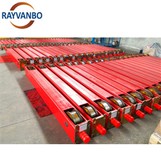
As a Crane Wheel Block supplier, we understand the importance of providing high - quality gearboxes and wheel blocks to our customers. We offer a wide range of Crane End Carriage and End Carriage Of Eot Crane products that are designed to meet the diverse needs of different crane applications.
If you are in the market for crane wheel blocks or related components, we invite you to contact us for a detailed discussion. Our team of experts is ready to assist you in selecting the right products for your specific requirements. Let's work together to ensure the smooth and efficient operation of your cranes.
References
- "Crane Design and Engineering Handbook"
- "Gear Technology: Fundamentals and Applications"